Showing posts with label noticing. Show all posts

Sunday, September 1, 2019

To gesture or not to gesture (to provide spontaneous correction in language teaching) Part 1

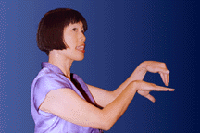
A new study by Nakatsukasa (2019) demonstrates that using simple gesture to correct grammar (use of the 'ed' past tense) may not work. Amen to that. Signalling with a deictic/metaphorical gesture as the instructor recasts (repeats) the piece of language correctly when there is a error--and not requiring any kind of response from the learner--and furthermore still expecting some kind of meaningful uptake or noticing is . . .well . . . silly, but good to see that proved conclusively.

From the study:

"When the participants did not use the past tense in the obligatory context in two tasks, the researcher consistently provided recasts with or without gestures (pointing back over shoulder with thumb) immediately following the participants’ utterances, depending on learners’ assigned conditions."

clker.com
Now that, in principle, sounds like a pretty good signalling technique, one which I have seen used "repeatedly" over the years by teachers (Hudson, 2011). But . . .

"For the VR condition (verbal recast w/o gesture), the researcher provided recast only verbally, putting her hands down next to the side of her body to avoid gesturing."

Now, does that (standing motionless w/hands at sides) sound like anything close to natural teacher behavior/gesture? Really? I have got to see a video of that!  In fact, I’d really have to see a video of everything that went on, to make sense of the study.

"In addition, the researcher tried not to stress any part of the recast in either condition to keep consistency."

Wow. How could you provide anything close to effective, meaningful feedback without stressing the part of the defective sentence or phrase that is being corrected?

"In all the instances, learners had the opportunity to modify their output; however, production of modified output was not enforced in the present study, to keep the flow of interaction and the saliency of feedback as equal as possible across conditions."

Not requiring at least some minimal "embodied" verbal response to such a gesture seems about as disembodying as you can get! Apparently, it was.

The research on the use of simple recasts, as Nakatsukasa points out, is pretty clear that they are, for the most part, not worth wasting your time on. So, "pointing out" a basically ineffectual recast with a disembodied gesture is supposed to make it more effective? It didn't. Surprise.

This is an important study, however, in that it represents quite accurately, I think, the way in which many researchers and practitioners view the place of gesture in language teaching, or even human communication for that matter: "add ons" that can be understood out of context and disembodied (not demanding a corresponding physical response in the body and mind of the other--the learner, as if gesture can be understood independent of the meaningful interaction in which it occurs.)

Something of a “How not to” guide of sorts.

What then is the "right" embodied and contextualized way to use gesture in teaching? Thought you were never going to ask! See Part 2, The right (haptic) way to use gesture in (at least) pronunciation teaching. Forthcoming, shortly!

Source:
Nakatsukasa, K. (2019). Gesture-enhanced recasts have limited effects: A case of the regular past tense, Language Teaching Research (11)1-29.


Tuesday, July 21, 2015

Back to the future of pronunciation teaching (and the "Goldfish" standard for attention management)

You apparently have a bit more than 8 seconds to read this post. So you may want to just scroll down to the conclusion and start there . . .

Clip art: 
Capturing and holding attention, if only for a few seconds, is the key to effective change in pronunciation work, especially for "mechanical" adjustments--and most other things in life. In earlier blog posts, the "gold standard" or is sine qua non of haptic pronunciation work has been seen to be about 3 seconds. In other words, for a learner to adequately experience the totality of a new sound or word, physically, auditorily, visually and conceptually--connecting things together, before moving on to practice or at least noticing or any chance at "uptake"-- takes complete, undivided attention for at least that long or longer.

Even that is often an unrealistic requirement with all the other potential distractions in the classroom or visual field. Research on the effectiveness of recasting learner utterances by instructors, for example, (Loewen and Philip, 2006) suggests that most of the time that strategy is relatively ineffective. One critical variable is always the quality or intentionality of learner attention, both in term of what the function the instructor is attempting to carry out and general learner receptivity.
Clker.com

Recall that Microsoft claims that our collective attention span, in part due to the impact of technology, has now dropped to about 8 seconds, just below that of the goldfish. (The UK Telegraph report is much more entertaining than that from the techies.

A new study by Moher, Anderson and Song of Brown University, summarized by Science Daily.com, adds a fascinating piece to the puzzle and may suggest how to begin to maintain attention better in class. What they discovered in an experimental study was that their subjects were, in effect, better able to "block" obvious distractions than they were more subtle ones. Backgrounded images in the visual field had more effect on subsequent action than did foregrounded, more striking elements which appeared to be easier for the brain to manage or ignore. They seem to have "discovered" one possible path into the mind by subliminal stimuli, evading first line conceptual or perceptual defences.

What is the obvious "subtle, unobtrusive, yet potent" application to pronunciation teaching? If you don't have "full body, mind and visual field" attention, there is no telling what is interfering with anchoring of sound change in the brain and subsequent total or partial recall.

Early on in EHIEP (Essential Haptic-integrated English Pronunciation) work I experimented extensively with controlling eye movement, in part to maintain concentration and attention, based primarily on the research underlying the therapeutic model of "Observed experiential integration" (See citation below) developed by  Bradshaw and Cook (2011). The effect was dramatic in working with individuals but applying those techniques to the classroom proved at least impractical. In part because the haptic pedagogical system was just developing, I backed off from eye patterning techniques in pronunciation work in 2009.

Based on Moher et al's research, however, it is perhaps time to again give directed eye movement management a "second look" in our work, going back to what I believe is the (haptic) future of pronunciation instruction, especially in virtual, computer-mediated applications.

Will report back on an in progress exploratory study with one learner using some eye movement management later this summer. Not surprisingly I am already "seeing" some promising results, attending to features of the teaching session that I would normally not have noticed!

Full citations:

Brown University. "Surprise: Subtle distractors may divert action more than overt ones." ScienceDaily. ScienceDaily, 16 July 2015, www.sciencedaily.com/releases/2015/07/150716123831.htm. (Jeff Moher, Brian A. Anderson , Joo-Hyun Song. Dissociable Effects of Salience on Attention and Goal-Directed Action. Current Biology, 2015 DOI: 10.1016/j.cub.2015.06.029)

Bradshaw, R. A., Cook, A., McDonald, M. J. (2011). Observed experiential integration (OEI): Discovery and development of a new set of trauma therapy techniques. Journal of Psychotherapy Integration, 21(2), 104-171.

Loewen, S., and Philip, J. (2006). Recasts in the adult English L2 classroom: Characteristics, explicitness, and effectiveness. The Modern Language Journal, 90, 536-556.

Saturday, March 7, 2015

Signs of spontaneous change in pronunciation teaching: more than just "weist darauf hin" . . .

Photo credit: Sunburst media.com
Marsha Chan has a "handy" system (including demonstration video) for using the hands to support English pronunciation teaching. Have used aspects of it and similar techniques for decades. Still do, in fact. Adam Brown describes somewhat similar techniques in teaching phonetics.

Chan's repertoire of hand gestures used for both initial teaching and providing feedback is, in many ways, emblematic of behaviourist approaches to language teaching: the instructor signals to the learner, points out what to correct. The idea is that the learner then takes note or "uptakes" the correction and goes ahead to integrate that new form into spontaneous speaking or at least spontaneous listening.

Had a German English teaching colleague a couple of decades ago who fervently believed that to "weist darauf hin" (point out) was his only pedagogical responsibility when it came to assisting students with pronunciation change. It was their problem from there on . . . He, too,  had a neat gesture system. It was, indeed, only a "gesture," however.

We "hapticians" (haptic pronunciation teaching enthusiasts) who work with EHIEP (Essential haptic-integrated English Pronunciation) or the haptic video system, AHEPS (Acton Haptic English Pronunciation System) have been focusing for some time now on spontaneous correction of pronunciation in class. The basic concept is that (a) students have been earlier introduced to not just a sign that lets them know what they may need to work on, but rather (b) how to figure out the source of the problem, themselves, and (c) what to do once they do.

For example, say a student uses the wrong vowel in a word. The interaction may go something like this:

A. Instructor: What is the number of the vowel in that word? (Morley, 1992)
B. Learner: (Considers for a second and then takes her best guess: "Ah . . . vowel #4)
C. Instructor either confirms or provides the correct vowel number.
Students had earlier been introduced to the vowel system and a set of haptic techniques for anchoring the sound (with gesture and touch). 
D. Learner and instructor then practice the word briefly 3 or 4 times together with a (haptic) pedagogical movement pattern, i.e., "Do that word with me!" (We do not use the dictum: Repeat after me.)
E. Learner writes down the problematic word/phrase immediately and then later
F. She puts it on her current practice word list that is systematically practiced for about 2 weeks, 3x each week.

If you are new to haptic pronunciation teaching, now might be a good time to "sign on!" A good place to start would be at the Haptic Pronunciation Teaching Workshop on Saturday, March 28th, 9:30 a.m., at the TESOL Convention in Toronto!


Thursday, February 13, 2014

Correct pronunciation by talking about it: Think or swim . . .

Photo credit: Seaglobe.com
Ever notice how students often will not notice well enough to "get it"  when you point out a pronunciation issue for them and skillfully provide them with a preferred form on the spot?

A recent study of noticing by Hanna, Mullainathan and Scwartzstein (2012) suggests something of why from a different perspective. When their subjects, seaweed farmers, were presented with data that was potentially very valuable for them in improving their work and problem solving, they didn't "uptake" much either--unless the relevance of the key elements was also explicitly linked back to why they were critical or relevant.

In other words, the new data had to be immediately linked (somehow) to acknowledged and perceived (or felt) relevance, what we (following Gendlin, 1972) refer to as "felt sense." In pronunciation teaching with adults, that at least means "getting back in touch with" earlier explicit explanation and guided practice. The problem is often, without sufficient physical experience and practice of the sound change in the first place or in the referring "teachable moment," there is little chance for most that merely pointing out or covertly throwing in correct models is going to work.

And taking valuable class time in the middle of a content-based discussion, for example, to go into an impromptu explanation right there as to why that particular sound issue is important to intelligibility for some subset of learners will probably not be productive either. So what should you do?

What does work, in our experience, in EHIEP/AHEPS, is haptic anchoring (gesture + touch on stressed words or syllables), that is much more strongly body-based initial experience of the sound or word. Having intensely experienced the physical properties of the sound early on, learners then have better access to that anchor when it is activated in a meaningful context. (The basic trick involved in hypnotic suggestion.) The primary contribution of haptic engagement in pronunciation learning or any learning system is integrating the senses, providing the link back to the experience and sound later.

That way, in spontaneous conversation or classroom talk, after a problematic word or stress pattern occurs, with a quick "haptic-anchored noticing" as the word is repeated by the instructor, often w/out even saying the word out loud, the connection is made. The same principle holds if the instructor, aware of a feature that a student or students are working on, haptically anchors some element as he or she produces it in doing an explanation or providing a comment: the visual gesture accompanying the spoken word is often enough for students to "feel" and register that token.

How well that works consistently is, of course, an empirical question, one that can and will be researched in time. In the meantime, take it from the seaweed farmers. The only way to experience this level of somatic, whole-body, experiential learning . . . is to jump in the (haptic teaching) water .  .  . and notice what happens. As we say, "Think or swim . . . take your pick!

Keep in touch.


Thursday, October 31, 2013

"Aha! change uptake!" versus the "practice" of haptic pronunciation teaching


For a while I had a special label for research reports that managed to confirm what any teacher with a modicum of common sense had figured out already, the "Well . . . duh!" category. There are any number of studies that demonstrate that practice, in addition to in-class work, is essential--in many different fields. In this field there are only a few. I cited one earlier, a 2010 study by Yoshida of Purdue University: those students who practiced pronunciation outside of class did better, significantly so.
Clip art: 
Clker
With only a few exceptions, and for the most part with good reason, classroom-based research focuses on in-class or in-lab treatment, not what happens beyond those contexts. In part that is because, contemporary methodology often implicitly must assume that nothing is going to happen outside of class of theoretical interest, whether the context is EFL or elsewhere. 

Decades ago, when ESL was still the conceptual center of pedagogy, you could tell students to go out there and practice, letting yourself off the hook. No longer. We talked about bringing the world into the classroom. For many, the "world" of language learning is now limited to the classroom--and maybe with random assistance of "my technology."

Pronunciation instructors who assume that just in class instruction, without any formal follow up, either face to face or as monitored homework, is sufficient may get lucky occasionally. There are, indeed, those rare, highly receptive students and memorable "Aha! change uptake," teachable moments when a lesson is life- or interlanguage pronunciation- altering, when explanation and insight and contextualized practice and uptake all collide! If you recall one, however, please describe it in a comment to this post! (Generous reward offered!) 

For Essential haptic-integrated English pronunciation model (EHIEP), and its haptic video offspring, Acton Haptic-integrated English pronunciation system (AH-EPS), practice is the sine qua non of pronunciation change. Haptic anchoring (gesture, plus vocal resonance positioned in the visual field consistently), sets up the process well but requires follow up, either in integrated focus on form by the instructor and peers, or practice outside of class, preferably with a technology assist. 

Haptic engagement, by its very nature is exploratory and at least temporarily very somatically attention grabbing (emotionally gripping.) But it is not sufficient. (That is, in part, why gesture work, in general, feels so good but rarely, by itself, sticks, to use a good haptic metaphor.) 

Next post will back up a bit and look at research underlying the relationship between haptic anchoring and subsequent noticing and practice. Keep in touch. 


Monday, February 11, 2013

Connecting "internal" pronunciation memory with "external" movement and vocal resonance

Clip art: Clker
Now, granted, this one is a bit of a stretch but it is certainly headed in the right direction . . . from a new study on motor memory by Smith of Harvard university, summarized by Science Daily, connecting internal (brain only) motor memory with memory for "external," physical body movement. The concept is that the neurons that actually manage physical movement are much more closely related to those that "store" or generate that action in the brain than has been generally assumed in contemporary neurological theory. Now why is potentially very big?

Clip art: Clker
In part, it suggests that in haptic-integrated clinical pronunciation work, for example, procedures that focus learners' attention more on the "physical" or "somatic" dimensions of sound production and comprehension should, correspondingly, have greater impact on memory for the sounds and later recall--than do more cognitive functions such as insight, systems "noticing" and context embedding. In other words, this seems to explain why over-reliance on metacognitive activities in pronunciation teaching such as explanation, reflection and rule schemas may not be all that effective in assisting learners in integrating new and corrected pronunciation into spontaneous speech.

Bottom line: Get connected with haptic pronunciation teaching!

Saturday, February 2, 2013

Collaborative pronunciation group work--by design!

Clip art: Clker
There is , as far as I can tell, virtually no accessible, published research on the efficacy of group work in pronunciation teaching. (If you know of some PLEASE post a comment with the link!) There are any number of informal reports and recommendations along those lines, including Gilbert (2008) (a free pdf that you should be familiar with already!) that has some good ideas for pair work on stress assignment and intelligibility of vowel and consonant articulation, a good complement to the Acton Haptic - English Pronunciation System, AH-EPS. (See earlier post  and sidebar on name changes of both our company and what was formerly the "EHIEP" or "HIPOECES" system. Change . . . )

New research by Vaquero of Hewlett-Packard and Cebrian of the University of San Diego, summarized by Science Daily, demonstrates the potential benefits of group collaborative work, as opposed to working alone. So far, so good. But, get this: " . . . almost equally interesting is the fact that these high-performing students form 'rich-clubs', which shield themselves from low-performing students, despite the significant efforts by these lower-ranking students to join them. The weaker students try hard to engage with the elite group intensively, but can't. This ends up having a marked correlation with their dropout rates."

So, in pronunciation work, especially in classes of mixed ability, how do you do effective group work, if at all? Separate out the "rich" and "poor" clubs? Integrate them? For most, the answer is "Neither!" In AH-EPS work, where developing accurate pedagogical movement patterns (PMPs) is one important feature each module--not initial phonetic accuracy, the opportunity for mixed-level group work is excellent. (In fact, many times there appears to be little or no early correlation between "haptic-ability" and proficiency.)

The nonverbal, collaborative communication centers on PMP execution--best done in groups of three or more--coordinating it with articulation of the sound, sound pattern, stress, rhythm or intonation assignment. (Note: The key "haptic"  principle here is that accurate PMP anchoring should, by itself, in short order enable more accurate articulation--without a great deal of conscious, auditory self-monitoring.)

Any pronunciation class can, in principle, be "grouped" in attending to some suprasegmental targets, such as in Gilbert (2008). For the most part AH-EPS group and (potentially) homework practice is also wonderfully stress-free and noncompetitive--and egalitarian! A "rich" source of anchored, focused noticing. Ah! (or AH!) a new acronym even: AnFoNot!


Monday, December 31, 2012

Can't see how to say it right? (Self-reflective, visual-soma-kinaesthetic correction of mispronunciation)

So you try to demonstrate with your face and mouth how a learner should be pronouncing a vowel, for example--and it simply does not work. In fact, the mispronunciation may just get worse. New research by Cook of City University London, Johnston of University College London, and Heyes of the University of Oxford (Summarized by Science Daily) may suggest why: visual feedback of the difference between one's facial gesture and that of a model can be effective in promoting accommodation; simple proprioceptic feedback (i.e., trying to connect up the correct model with the movements of the muscles in your face, without seeing what you are doing simultaneously) generally does not work very well. Amen, eh.

I have had students whose brains are wired so that they can make that translation easily, but they are the exception. The solution? Sometimes a mirror works "mirror-cles;" some new software systems (noted in earlier blogs) actually does come up with a computer simulation that attempts to show the learner what is going on wrong inside the mouth and what should be instead--with apparently very modest, but expensive results.

Clip art: Clker
Clip art: Clker
The EHIEP approach is to early on anchor the positioning and movement of the jaw and tongue to pedagogical movement patterns of the arms and hands. From that perspective, it is relatively easy, at least on vowels, stress and intonation (and some consonants) to provide the learner with both visual, auditory and proprioceptic feedback simultaneously, showing both the appropriate model and how the learner's version deviates. (In fact, in some correction routines, it is better to anchor the incorrect articulation first, before going to the "correct" one.) In effect, "(Only if) Monkey see (him or her mis-speak), (can) Monkey do (anything about it!)"


Friday, December 28, 2012

Pronunciation feedback: the quicker, the better?

Clip art: Clker
The research on corrective feedback in language learning is extensive. The conclusions are a mixed bag, at best. I do not recall seeing a study that measured the effect of anticipated feedback, whether immediate or postponed in the literature. I had missed this 2010 study by Kettle and Haubi of the University of Alberta (summarized by Science Daily) where they looked at the impact on test scores when subjects thought that they'd be given immediate, rather than delayed feedback. Those in the first group estimated their performance to be somewhat lower but did better than the latter group, which tended to overestimate their final score.

Pronunciation feedback in general tends to be more postponed, often in the form of notes to the student or critique of audio recordings. In class, real time responses to mispronunciations are less in fashion than during earlier periods when oral accuracy was strongly promoted and learners were often pressed to speak more in class and be immediately corrected than today. In survey after survey, learners desire more spontaneous correction and instructors appear less and less likely to comply.

Clip art: Clker
A solution to that, one that we (and many others) have developed in haptic-integrated work, is to use a set of gesture-based signals (perhaps including a vowel number) to alert the learner effectively to problematic pronunciation without requiring excessive public performance. That way the learner can immediately note the problem and either deal with it "internally" or go back and work on it later, perhaps talking with the instructor or another source privately, if necessary. Just the impact of that anticipatory attitude on motivation, according to the research, is worth the cost of tuition. Can hardly wait, eh?

Friday, July 13, 2012

The "Nocebo" effect in pronunciation teaching.

Clipart: Clker

Clipart: Clker
I wrote an article in 1997 entitled "Seven suggestions of highly successful pronunciation teaching." It began with a quote from the introduction of a then popular pronunciation book (no longer in print):

"Acquiring good pronunciation is the most difficult part of learning a new language. As you improve your articulation you have to learn to listen and imitate all over again. As with any activity you wish to do well, you have to practice, practice, practice, and then practice some more . Remember that you cannot accomplish good pronunciation overnight; improvement takes time. Some students may find it more difficult than others and will need more time than others to improve (Orion, 1988, pp. xxiii-iv)." 

My point in quoting that rather foreboding piece was to illustrate the sometimes "less than encouraging"  language (and attitude) used by instructors to orient learners or attempt to motivate them during pronunciation work. At the time I didn't have a term for it; now I do: a "nocebo"--as contrasted with a "placebo." In the research summary by Winfried Häuser and co-researchers of the Technical University of Munich, summarized by Science Daily, defined 'nocebo' effects as " . . . adverse events that occur during sham treatment and/or as a result of negative expectations . .   or by unintended negative suggestion on the part of doctors or nurses. . ." The above "nocebo" may, for many, be at face value a realistic prognosis, but there is almost certainly a less "nocebic" way to put it. So, along with "noticing" we need to add the term "nocebo-ing" or "nocebo-ation" to our haptic toolbox--or try to eliminate it!


Wednesday, October 26, 2011

Pronunciation change is just (like) a piece of (cup) cake!

Clip art: Clker
Another nice summary from Science Digest. It is, indeed, so intriguing that I really hesitate to even explain it. What the study demonstrated was that word of mouth (WOM) explanation had differing effects on attractiveness or emotional engagement, depending on whether the object in question was to be a sensory or "hedonic" experience (such anticipation at eating a cupcake) or more practical or functional (such as buying a new USB stick.) As the researcher Moore (University of Alberta) notes, "Although we have a natural tendency to explain the events in our lives, it is not always in our best interests to do so." Explanation tended to enhance attractiveness of the USB stick and diminish appeal of the cupcake.

Likewise, the parallel for our work--since we certainly do do WOM!-- would be that to the extent that pronunciation change is essentially physical/somatic (Cognitive Phonologists' "manifesto" not withstanding), excessive explanation and "meta-cognating" on it may work against adequate engagement. On the other hand, doing the same with grammar or rhetorical analysis or verb conjugations might just have the opposite effect. Delicious thought, eh? Don't mention it . . .

Sunday, October 23, 2011

Sticky, persistent, integrated pronunciation change

Disintegration of Persistence
of Memory by S. Dali:
Credit: Wikipedia
A favorite image or visual metaphor of mine for the current state of pronunciation teaching, especially understanding of how to make change "stick" is Dali's "Disintegration of Persistence of Memory." Although the 1954 painting probably relates a little better to the evolving mind and memory of modern man than getting learners to integrate repaired or new pronunciation, the existential issue is the same: flooded with information, insight and other random "edutainments," how can we remember anything? Better yet, with virtual memory in the "clouds" all around us now, why bother?

Several aspects of pronunciation change still require decidedly "pre-modern" kinaesthetic engagement to stick efficiently, where the potentially neurotic, "self talk" interference is at least temporarily absent--what a recent post referred to as "mindfulness" focusing on just one objective: anchoring in memory, or in HICP terms, haptic anchoring. In yesterday's workshop, in response to the question: "What makes pronunciation change stick?",  the suggestions from the audience ranged from "context" to "real communication" to "opportunities for usage" to "collocation" to "paradigm-relation" (similar form) to "comprehensible input" to "personal relevance."

What was not mentioned is most revealing: saying the word or phrase out loud for practice or some kind of somatic "felt sense" of the sound(s), the basis of HICP work. It is as if much of the basic understanding of how pronunciation was to be integrated or "drilled in" of only a couple of decades ago has been lost. Stick with us. Memory persists here . . .

Friday, October 21, 2011

The Magic of Pronunciation instruction: distractions and "Burriers!"

Adam Gopnik, quoting Jamy Ian Swiss on distractions [in magic]: "Magic only ‘happens’ in a spectator’s mind….Everything else is a distraction. . . . Methods for their own sake are a distraction. You cannot cross over into the world of magic until you put everything else aside and behind you—including your own desires and needs—and focus on bringing an experience to the audience. This is magic. Nothing else."

Clip art: Clker
Several recent posts have pointed to the problem of capturing the complete attention of the learner in anchoring pronunciation change. The distraction may be of many kinds, from formal instruction to wandering thoughts of tomorrow's fishing trip to past worries. For haptic anchoring in the instructional process to work, the "magic" must be there. The learner must be completely "in" the moment, the felt sense of the sound without distraction.

Whereas in magic the distraction is used to draw attention away from the slight of hand, in HICP the pedagogical movement patterns of the hands, in a sense, create a similar distraction, keeping the eyes "entertained" so the sound and somatic experience can be absorbed better. In fact, it may be necessary to first perform a preliminary trick--what we call a "Burri-er,"  named after Mike Burri, who recently reminded me of that technique, which we had experimented with a few years ago. To turn off the cognitive, analytic pre-frontal side of the house in the head temporarily, when it cannot shut up and stop commenting on what is going on, we may use a procedure like that developed in EMDR and other "quick change" therapies (noted in earlier posts.)

For example, try having patients/learners follow their hands with their eyes, going back and forth slowly in the visual field between 9 o'clock and 3 o'clock for about 30 seconds. (That has been shown to also improve performance on problem solving for some right handed college sophomores at least . . . ) A quick little "Burri-er" such as that should remove any barriers . . . like magic!

Thursday, October 20, 2011

"Sensational" pronunciation teaching? Chances are about 50/50.

Clip art: CLker
Here is a brief summary of an article by Killingsworth and Gilbert published in the journal, Science. It includes this interesting quote from the article: “The ability to think about what isn’t happening is a significant cognitive achievement, but one that comes at an emotional cost.” The data revealed that most of us are "in the present moment" emotionally, only about 50% of the time, at best. The concept of "mindfulness," sensing as much as possible the "felt sense" of our body (e.g., heart rate, muscle tension, breathing) and learning to function within it--not trying to escape it or cool it down consciously-- is applied extensively in many fields today.

One of the great advantages of multiple modality instruction is that it provides a means of (at least momentarily) capturing the full attention of the mind to the task at hand. Haptic techniques, engaging the body as they do, if done with correct form and perhaps some eye tracking, are "mindful" or mind-filling in the best (felt) sense. It is not that clear explanations, discussion, insight, planning and disembodied drilling related to a learner's pronunciation are not helpful; they are, of course--but they can also easily interfere with efficient anchoring of sound change.

In other words, stop thinking about pronunciation and how difficult, time-consuming and anxiety-producing it can be. Just do it (haptically)!