Showing posts with label body movement. Show all posts

Wednesday, August 9, 2023

Talk (to) Yourself into Improved English Fluency! (an almost DO-IT-YOURSELF course!)

Clker.com
And how do you do that? In part, using embodied oral reading to develop English fluency and confidence. The efficacy and methodology for the various applications for oral reading is well established. (For an excellent review of oral reading research and methodology, see Fuchs, Fuchs, Hosp and Jenkins, 2001) )

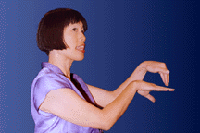
What haptic pronunciation teaching has brought to the party beginning in about 2007 has been the systematic use of the body and body movement in pronunciation teaching. What that means, in effect, is that every word in the selected oral reading is "choreographed" with some degree of conscious engagement of the upper body, generally focusing on rhythm of English but also, in principle, any phonological feature of any language. 

The concept of improving your speaking fluency in private, at least certain features of it, without talking with or working with another person or instructor, is today an almost radical position, as opposed to the prevailing social-constructivist, communicative view of ideal (probably group-based) context and input. Although it is difficult to establish empirically, of course, in reality the preponderance of ALL language learning happens as learners do "homework", either internal "self talk" or explicitly out loud speaking . . .  in private. 

That successful L2 learners can improve their fluency away from public engagement is pretty much a given. (By fluency here I am limiting the discussion to the learner's ability to speaking  rhythmically and confidently--and more rapidly, using language elements that they are capable of articulating, often very haltingly or not at all.)

The model of that methodology adopted by haptic pronunciation on this blog and elsewhere has been based on that of Lessac, presented in his book, The use and training of the human voice. Although the approach was developed essentially for native speakers and many actors or public speakers in process, the principles and system are beautifully compatible with confidence and fluency development for nonnative speakers as well. In that system, learners are first reoriented to the basic movement and somatic energy in their bodies, very much like contemporary "mindfulness" therapies, for example. 

What was extraordinary back then--and even now--was the design where the entire 12-step process could be done by one person, alone, just using the book, following the plan. (One can, of course, today take courses in the Lessac method internationally, but the central premise holds: for speech fluency, as defined earlier, there is a great deal one can do on their own, such that it carries over very well into spontaneous speaking engagement.)

That, in essence, is how the KINETIK, haptic-based course works. Unfortunately, the October-December, Acton Haptic English Fluency Training (HFT) course offered through Trinity Western University is closed!!! However, there is still plenty of time, however, to set up a customized course with your organization for next spring, or plan to enroll for the upcomng January~March course. (for further information on either option, email me: wracton@gmail.com

A few excerpts from the HFT course description: 

HFT Embodied Oral Reading is done out loud, in private, using stories that are accompanied by special gestures which use language and vocabulary that students are already familiar with, what they can understand, but perhaps may not be able to talk about fluently.

The 9-week course is designed especially for non-native English-speaking adults who do not have the opportunity for much, if any English, face-to-face conversation in their daily lives but who want to keep improving, nonetheless. (and who have an IELTS reading ability of about 4.0 or above.) HFT provides the student with a set of skills so that they can continue improving after the course, working with other readings of interest to them. It is recommended, for example, for students who are not studying spoken/conversational English currently.

It is based on extensive research (and decades of teaching experience) in oral reading methodology and the well-known "Lectio Divina" tradition in meditation practice, using extensive oral reading as homework—not in a class. The key neuroscience-based innovation of HFT is the precise use of gestures and touch in the visual field, synchronized with speech, creating optimal conditions for attention, learning, retention and recall.

Course work is done individually, with four or five, 30-minute homework assignments and a live 75-minute zoom feedback meeting weekly, usually on Friday evening. (which is also recorded for later access, if necessary.)

Next course: January ~ March, 2024

·Cost for individuals: $350 USD, materials included, but for a school, for example, (maximum of 100 students) the cost per student can be as low as $25 USD.

A teacher training course in Haptic Pronunciation Teaching is also available (See www.actonhaptic/KINETIK

To enroll or for more info, go to www.actonhaptic/hft or contact Bill Acton at wracton@gmail.com

Full citation: 
Fuchs, L., Fuchs, D., Hosp, M. & Jenkins, J. 2021. Oral Reading Fluency as an Indicator of Reading Competence: A Theoretical, Empirical, and Historical Analysis DOI: 10.4324/9781410608246-3, in (Eds) Kamee'enui, E. & Simmons, D. 2002. The Role of Fluency in Reading Competence, Assessment, and instruction: Fluency at the intersection of Accuracy and Speed: A Special Issue of scientific Studies of Reading, New York: Rutledge, pp. 239-256


Saturday, December 24, 2022

Ben Bruno's "10 Commandments of physical training" applied to pronunciation teaching!

Ben Bruno, personal trainer to the stars, has a super set of principles for training that could as well be a guide to (haptic) pronunciation teaching. Use the following as something of a test for your method about either: 

Here they are: (the boldfacing and extrapolations are mine!)

1. Thou shalt not train through pain.

    ๐Ÿ’ช Pronunciation work works when at least you can focus just on it for bit. 

2. Think of strength training as your entrรฉe and cardio as the side dish. Both have their place but divvy your time and energy accordingly. 

    ๐Ÿ’ช At least for a time, attention to accurate, good form must supersede being fluent. 

3. The hard exercises that you hate doing are generally the ones that work the best. Sorry. 

    ๐Ÿ’ช Repetition, especially where a new physical patterning is being established, may not be mentally stimulating but it can be key to establishing the anchoring and access for a new sound or word. 

4. You can always make a mistake not to train, but at some point you just have to make time for it. Or be weak and out of shape. 

    ๐Ÿ’ช For most learners, consistent, relatively long term practice is key. And, like physical training, a new sound or pattern is not acquired unless do, indeed, "use it or lose it" if there is not sufficient consistent practice. 

5. Thou shalt train thy legs. 

    ๐Ÿ’ช The "legs" of pronunciation work is at least the rest of the body from the neck down, but in haptic work, the entire mind-body nexus. 

6. Mobility work is boring. Do it anyway.

    ๐Ÿ’ช The analogs here are (a) warming up or stretching, and (b) general fluency exercises where the body moves "fluently," along with speaking, for example. 

7. Remember that outside the gym, no one cares what you did for your workout, or about your diet. Keep it to yourself

    ๐Ÿ’ช Unless you are working with somebody, like a partner or instructor, your progress and goals are critical and only you can judge how things are going, certainly not a non-informed bystander. 

8. Similarly, nobody cares how much you lift. Drop the ego, drop the weight, and do it right. Form matters. 

    ๐Ÿ’ช Two principles there, dropping the ego . . . and form (See Principle #2)

9. Train the muscles  you can't see in the mirror (glutes, hamstrings, back, etc.) more than the muscles that you can see (pecs, biceps, etc.). It's good for you, and just because you can't see them, everyone else still can.

    ๐Ÿ’ช In other words, the rest of the body, especially the quality and resonance of your voice, overall relaxation and breathing techniques

10. Don't overcomplicate things. Always be learning, but at some point you have to put down the books and pick up the weights

    ๐Ÿ’ช The  bottom line: The process requires extensive "performance" without overthink or even conscious processing of the meaning of what is being spoken out loud for success. 

Ben's 10 has improved my approach to both kinds of training already--since both are so interrelated anyway. In fact, it will form something of the foundation for a new project I'm working on. 

Keep in touch!

Bill


Sunday, September 18, 2022

Killing (Pronunciation) Learning 16*: Move (with) it or Lose it!

Cilker.com
Fascinating new research--with intriguing implications: "Hand constraint reduces brain activity and affects the speed of verbal responses on semantic tasks,“ by Onishi, Tobita and Makioka of Osaka Metropolitan University, one that gives the metaphor to "sit on your hands," neuroscientific validation . . .almost!

In the study, subjects sat at computers and had to make judgments as to the relative size of different objects on the screen. In one condition, subjects viewing objects that entailed the use of the hands, such as a broom, were not allowed move their hands as they responded. That significantly slowed down brain processing, compared to responding to objects, such as a house, which do not involve as direct hand engagement or learning experience, where the restraint on their hand movement had no discernable effect. 

From the perspective of embodied cognition theory that makes sense, where, in principle, all learning . . and thought is inexorably bound together with the entire body in multiple dimensions. Some of that interconnectedness derives from when something is learned; some, from the primal notion that all experience is embodied, that is grounded in what the body is doing either in saving to memory or memory access. 

Assuming that general principle holds--and I am absolutely convinced that it does from about 50 years in the field of pronunciation teaching--how does impact our understanding of the function of body movement in the classroom? For one, requiring students to sit near motionless, especially in language learning, let alone elementary school classrooms, is a killer, best case. Just being able to move around a little, keeping loose and responding easily and with all your body (and being) means something, literally. That is something we all know intuitively, of course, but what the study shows is that at some level a body constraint is a "thought" constraint as well. 

In (haptic) pronunciation teaching, virtually all basic instruction is based on gesture-synchronized speech, where all speech production can be accompanied by gesture, and body awareness of constant motion and synchrony between body and speech rhythm develop throughout the process. The hands and arms play prominently in the method. For more on that: www.actonhaptic.com

Do a video of your class (any class) sometime. Is it moving? It should be . . . 

*This is number 16 in the series of blogposts highlighting factors or variables that can seriously interfere with learning and teaching pronunciation. 

Source:
Onishi, S., Tobita, K. & Makioka, S. Hand constraint reduces brain activity and affects the speed of verbal responses on semantic tasks. Sci Rep 12, 13545 (2022). https://doi.org/10.1038/s41598-022-17702-1

Wednesday, April 27, 2022

Pronunciation teaching: RIP (requiescat in pace--or not)

An earlier, 2018 study, summarized by ScienceDaily.com as Even mild physical activity immediately improves memory function, by researchers at the University of California-Irvine and Tsukuba University in Japan, points to a fascinating (and commonsensical) concept: movement for movement's sake in learning. Children (of all ages) know that you have to be moving constantly to learn anything. Neuroscience tells us basically the same thing: that Descartes was wrong: I MOVE therefore, I am--in apart because at some level in the brain, thought is movement. (Some argue very convincingly that movement comes first!) In the study, participants did 10 minutes of light exercise, yoga, walking, etc., before doing a memory test. The results were striking, due in part to " . . .better connectivity between the hippocampal dentate gyrus and cortical areas linked to detailed memory processing." Details, details . . . 

In case you haven't noticed, pronunciation teaching is generally not a high priority with most teachers, for a number of reasons, from the KINETIK Method perspective, lack of systematic movement being one of them: 

  • Just not enough time, too much other stuff to deal with--even if I do have some training in it.  
  • Although research in second language pronunciation has made enormous gains in the last decade, methodology of pronunciation teaching is still pretty much where it was several decades ago: explanation, repetition, reflection and communicative practice . . . then leave the rest to the individual student to figure things out
  • Internationally, with media and cultural integration and engagement--and the post-colonial milieu we are in, acceptance of far less than perfect British or American pronunciation has changed attitudes enormously. The demand, at least in some contexts, is just no longer there. 
  • With the availability and accessibility of English on the web and technology, learners can be exposed to so much more meaningful input and interaction that their pronunciation has a better chance to evolve, naturally or with a little help, far more effectively than in the past.
  • Even during in-class face-to-face instruction, there are also a myriad of factors that can undermine attention to pronunciation. The Zoom experience for the last couple of years has foregrounded a key element of pronunciation teaching and learning: engagement of the body, the impact of lack of physical engagement in various modes of instruction at a distance. In other words, resting peacefully (requiescat in pace) as you do (pronunciation) may really work against you . .  especially if you want to remember what you are studying. 
Recall that back in the 1980s one of the "boutique" teaching methods, Suggestopedia, actually used a number of procedures based on deep, hypnotic-like relaxation techniques accompanied by little or no motion involved, claiming to enhance speed of acquisition and memory. The method turned out to at least lack generalizability, and is no longer  . . . remembered! The Suwabe et al 2018 study looked at light exercise followed by the memory test. 

Perhaps what makes learning pronunciation most problematic is, in fact, the level of physical or somatic engagement. In the KINETIK Method, body engagement is managed or required extensively, both when speaking and when not. Turns out, you can get at least some enhancement of memory for what comes next just by doing a little "body work" in preparation. So . . . do it!

Source article:
Kazuya Suwabe, Kyeongho Byun, Kazuki Hyodo, Zachariah M. Reagh, Jared M. Roberts, Akira Matsushita, Kousaku Saotome, Genta Ochi, Takemune Fukuie, Kenji Suzuki, Yoshiyuki Sankai, Michael A. Yassa, Hideaki Soya. Rapid stimulation of human dentate gyrus function with acute mild exercise. Proceedings of the National Academy of Sciences, 2018; 201805668 DOI: 10.1073/pnas.1805668115


Monday, January 17, 2022

Improved pronunciation "in the blink of any eye!"

How important is general/not directly task-based body movement, especially the lack of it, to learning pronunciation, creativity or just learning? In haptic pronunciation teaching learners are encouraged or required to move almost constantly, primarily through speech-synchronized gesture, but also through "Mindfulness-like" practices that monitor the state of the muscles and posture of the body, along with breathing patterns. 

But what about the impact on learning when students' bodies are held more in check, with restricted motor engagement? A new study by Murali and Hรคndel of Julius-Maximilians-Universitรคt Wรผrzburg, Motor restrictions impair divergent thinking during walking and during sitting, summarized by ScienceDaily.com, not only affirms our intuitions about the central role of embodiment in thought and learning, but suggests something more: even while seated, a little movement appears to go a long way in maintaining creativity and attention. (What a shocker, eh? Hope you were sitting down when you read that!)

Ciker.com
The actual protocols of the research, which involved measurement of eye "blinking" responses as indices of degree of engagement, are not described in the summary, but the title of the original piece is interesting. To quote from the summary of the study: "Our research shows that it is not movement per se that helps us to think more flexibly," says neuroscientist Dr Barbara Hรคndel from Julius-Maximilians-Universitรคt Wรผrzburg (JMU) in Bavaria, Germany. Instead, the freedom to make self-determined movements (emphasis, mine there) is responsible for it." 

In other words, messing with the body's incredible range of what appear to be random movements, apparently unassociated with the task being consciously in focus, may have dramatic consequences. An extreme analogy might even be talking with friends who are somewhere on the autism or ADHD spectrums. Their body and eye movements seem to suggest that they are not pay sufficient attention when in fact that is not the case at all. 

Now I am not saying that "thinking more flexibly" at any moment in instructional time is necessarily a good thing, of course, but the principle of allowing the body to also think and create on its own on an ongoing basis, in some sense "non or extra-verbally," if  you will, certainly is. On behalf of all elementary school boys on the planet who have had to sit in/through years of class to learn with girls when we should, instead, have been outside learning with our hands and whole bodies, I can only say, AMEN! 

Think about it. While you were reading this blogpost, what "else" was your body doing? If you can't remember . . . Q.E.D (quod erat demonstrandum)

Keep in touch!

Bill

Original source: 

Supriya Murali, Barbara Hรคndel. Motor restrictions impair divergent thinking during walking and during sitting. Psychological Research, 2022; DOI: 10.1007/s00426-021-01636-w

Tuesday, January 19, 2021

Moving learners to be more positive and work together in (pronunciation) teaching: person or process?

One typical reason often given for not teaching pronunciation has to be something like: I don't feel comfortable having to be so outgoing and interpersonally "invasive" in messing with students' speech. Granted, many (if not near all) of the strongest proponents of pronunciation teaching, mea culpa, tend to be pretty far down the "extrovert" rabbit hole. In more traditional approaches to teaching you almost had to be to drive drill and other mindless practices with enthusiasm, motivation students to stay with it.  Being around someone who is excessively positive and extroverted can also get real annoying, eh!

Turns out, according to a non-significant study by Qui and Ho of Nanyang Technological University, Singapore, that all that extroverted talk and language may not really be contributing much to the process--a proposition that I, being an extrovert, endorse whole heartedly, enthusiastically! (but see below.) Based on a meta-analysis of about three dozen studies of extrovert behavior, they almost discovered that extroverts tend to use more "positive emotion words" and "social process words" than the rest of you. Taken from the Neuroscience News summary

"Positive emotion words are defined by psychologists – using text analysis tools – as words that describe a pleasant emotional state, such as ‘love’, ‘happy’, or ‘blessed’, or that indicate positivity or optimism, such as ‘beautiful’ or ‘nice’. Social process words include words containing personal pronouns except ‘I’, and words showing social intentions, such as ‘meet’, ‘share’ and ‘talk’."

Then, their conclusion: "Our results suggest that positive emotion words and social process words are linguistic correlates of extroversion, but they are small in magnitude." 

Really? By "small in magnitude" they mean their findings did not reach an r of 0.05 (0.069 and 0.077.) Normally, I don't report "near misses" like that, but since I like the conclusion, let us run with it a bit. What it "tells" me, is that what many see as the secret to setting up the most effective learning "atmosphere" in class, the use of "pedagogically correct" language that is generally positive, "grouply" discourse, does not depend on being personally . . . extroverted. So what does motivate (move) your students? You, your pedagogy or both? And how does that interaction really function in class? 

We discovered early on that uncontrolled enthusiasm, as great as it is for getting everybody on board, is near toxic in working with gesture, easily letting things get out "hand" or of control or focus--and very likely pronunciation, in general. In part, the reason for that being that the learner's attention can go almost anywhere in the visual field around them, affecting what is remembered from the session, compromising attention to sound, for example. Research (and common sense) has long established that both positive excitement and negative stress can wear you out equally, take you off your game. 

It's certainly about moving . . . moving learners to learn efficiently, metaphorically and physically. Try this: Evaluate your next three or four in-class or on Zoom lessons just in terms of relative quantity and quality of body movement, by both you and the class--a fundamental principle of haptic pronunciation teaching. 

One great way to do that is to record the session and then review it with the sound off. (If you are interested, let me know in the comments section and I'll share with you a rubric for that that we have developed for teacher training.) That will seriously impact/enhance your awareness and work on screen. Guaranteed. 

Achieving intentional, appropriate kinaesthetic engagement is critical in teaching with systematic gesture, as in HaPT. And it can't help but make you and students look and sound better as well! 
------
Bottom line: Being an extrovert should NOT be especially advantageous in pronunciation teaching, properly understood . . . like in the new (EXCITING!) iteration of haptic pronunciation teaching (HaPT.) I'm sure you saw that coming! Acton Haptic Pronunciation: Content Complement System (AHP:CCS) official roll out date is now 2/15/21. Check out previous blogpost for more info on that. ,

Original source:
A meta-analysis of linguistic markers of extraversion: Positive emotion and social process words” by Jiayu Chen Lin Qiu, Moon-Ho Ringo Ho. Journal of Research in Personality

Wednesday, May 29, 2019

Standing up for pronunciation teaching:12 rules

Clker.com
Reading (and thoroughly enjoying) Jordan Peterson's recent 2018 book, 12 Rules for Life: An Antidote for Chaos. Although every 'rule" could be applied to pronunciation teaching, two in particular present useful, unique "Petersonian" perspectives for us: (Ch 1: Stand up straight with your shoulders back, and Ch 10: Be precise in your speech.) Here we'll consider the application or extension of the first chapter, the idea that posture and movement could contribute importantly to effective pronunciation teaching, identity and confidence--the subject of more than a few posts in the past. Peterson adds a new, more contemporary and neuroscience twist.

Part of the focus of that first chapter is on the neurobiology of confidence and social dominance, much of it related to serotonin, which--at least in lobsters--strongly influences both upright posturing and the corresponding feeling of relative well being as correlates with the relative place of the individual in the social dominance hierarchy. Peterson's point is that the same principle applies to us all: our position in society is reflected in our biochemical makeup. Likewise, our physical posturing can affect, among other things, serotonin levels in the brain that are not easily changed or modified over time but can be by significant events or context.

What that means for haptic or more kinesthetic pronunciation teaching would be something like the following:
  1. Stand up a little straighter when you do pronunciation.
  2. Use more confident-sounding, slightly louder speech (possibly a bit higher or lower in pitch.)
  3. When doing public speaking, prepare enough so you sound confident, with planned gesture on key concepts or ideas. 
  4. (Always) use gesture for modeling or correction.
  5. Use fluid upper torso movement that naturally leads to better, upright posture and breathing.
  6. Use forward "bobbing-like" upper torso movement on main stress syllable when practicing just one word. 
  7. Position written text to be read or imitated at eye level (especially on your PC or laptop).
  8. Briefly warm up the body to activate key muscle groups.
  9. Structure homework practice to use the in-class postural and gestural principles.
  10. Oral reports should be done standing up, with clear guidance as to how to hold and position note cards, moving them at times for emphasis. 
  11. Be more precise in articulation but work on body rhythm at the same time. 
  12. Practice pronunciation using really meaningful text that has either marked or very transparent phrasal and sentence stress placement (anchored with gesture or upper torso body movement). 
How does your teaching M.O. stand up to that model?

Keep in touch!


Thursday, July 27, 2017

Killing pronunciation 7: Talking learners (and instructors) out of pronunciation change

Credit: Anna Shaw
How do you persuade students to work on their pronunciation--or sell them on it, especially pronunciation-related homework?  If you are using more "distal senses" such as sight and/or sound, according to a new study by Elder, Schlosser, Poor, Xu of Brigham Young University, summarized by Science Daily, you may not have the right approach. If, on the other "hand", your method evokes a more "proximal" sense experience (such as movement, touch and/or taste), you are probably on the right track. (I'm sure you can see where this is headed!)

The BYU study dealt with the impact of advertising on what type of pitch and/sensory imagery seems to get you to make a commitment to buy sooner, rather than later. The actual journal title, So Close I Can Almost Sense It: The Interplay between Sensory Imagery and Psychological Distance, describes the research well. What they found, not surprisingly, is that imagery connecting to or evoking a "felt" somatic response from the body, in effect, draws you in faster, and more effectively.

That does not mean that you DO something physical, only that the imagery on a screen in this case, may get the customer or learner's brain to respond AS IF actual touch or taste was involved, generating a very real feeling or taste-related memory. That mirroring effect, in part entertained by "mirror neurons" in the brain, is well established in brain research. To the brain under most circumstances the distinction between how we feel when we observe and do can be minimal. Turns out our metaphors are more than metaphors, in other words.

Some of the variability here may have to do with our personal instructional style in bringing learners' attention to, in this case, what they need to do outside of class. How do you do that? A list somewhere in the syllabus? An oral announcement? Something written on the board? A brief oral run through of what is to be done? A brief rehearsal w/students of what is to be done? What is very important here is not the actual classroom activity but the imagery that it evokes. And the key to that is what prior schema the classroom event is linking back to--and how, in the moment, it is delivered and experienced.

Pronunciation instruction done right is both an exceedingly physical and meta-cognitive process. What haptic work attempts to do is achieve that balance consistently. There are other ways to do that, of course, but most student textbooks, for example, either don't or can't, in part because the activities are presented and taught in a purely linear fashion. Haptic is ALWAYS simultaneous--sound, movement, and cognition (haptic) engagement, in effect, communicating more intentionally with learners in pronunciation change in and with somatic (body-based) imagery.

Still not sold? Try rereading the blog in the hot tub or on an exercise ball . . .

Full citation from ScienceDaily.com:
Brigham Young University. (2017, June 28). Now or later: How taste and sound affect when you buy: The way ads play on our senses influences the timing of our purchases. ScienceDaily. Retrieved July 23, 2017 from www.sciencedaily.com/releases/2017/06/170628095858.htm


Tuesday, May 9, 2017

Killing pronunciation 6: Eliminating distraction (and episodic memory) with gesture!

Clker.com
Have wondered for years why at times even the most ingenious use of gesture itself may not enhance memory for a sound or word. I assumed that it had something to do with what the learner was paying attention to at the time but had never seen any study that seemed to unpack that problem all that well. We know, for example, that visual distraction can effectively all but cancel out the impact of a haptic (movement + gesture) stimulus or haptic-anchored gesture. But why doesn't gesture generally just reinforce whatever is the focus of instruction or repetition? Turns out that it may be our Achilles Heel. Here's a clue.


A fascinating study by Laurent, Ensslin and Mari-Beffa (2015) entitled, An action to an object does not improve its episodic encoding, but removes distraction, illustrates the potentially double-edged nature of gesture. Without getting into the somewhat complex but innovative research design, what they discovered is that gesture accompanying focus on an object did not enhance episodic memory for the object and the context or surroundings but did strongly curtail distraction. evident in the diminished memory for other elements of the event. (Think of episodic memory as basically potential recall of emotional setting plus the 5 "W"s: who, what, where, why and when of a happening.) 

In other words, gesture accompanying a phrase, for example, should at least cut back on distracting features of the moment or context . . . but, other than that, it may not be adding much to the mix. It may be actually working against you.

At first glance, that may appear to at least to some extent undermine use of gesture in teaching. It does, in fact. Haptic pronunciation teaching, which uses gesture anchored by touch on stressed elements, is based on the principle that gesture that is not carefully controlled and focused with touch is "a wash" . . . it may or may not work. Over enthusiastic gesture use, for example, may not only turn off many of the students, compounded by cultural differences, but, in effect, it can be so distracting in itself that the language focus is lost entirely. 

It took me a couple of decades of working with kinesthetic pronunciation teaching techniques to figure that out. That insight came basically in the form of wildly divergent reports and feedback on gesture effectiveness by classroom teachers. Pronunciation teachers are generally by nature more "gesticular", often highly energetic and "moving" speakers. Perhaps you have to be in many contexts just to motivate students and maintain their attention, but it can, indeed, be our Achilles Heel. Is it yours? 

If so, get in touch (either with us or your local yoga, Alexander Technique, Lessac practitioner or Tai Chi shop!)

Source:
Laurent, X.; Ensslin, A. and  Mari-Beffa, P. (2015) An action to an object does not improve its episodic encoding, but removes distraction. Journal of Experimental Psychology: Human Perception and Performance 44(1), 244.


Saturday, January 28, 2017

Killing pronunciation improvement: better heard (and felt) but not seen!

Clker.com
Fascinating study, Visual Distractors Disrupt Audiovisual Integration Regardless of Stimulus Complexity, by Gibney, et al. Department of Neuroscience, Oberlin College.

Tigger warning: This is a thick, technical read, but the conclusions of the study have potentially important implications for pronunciation teaching, especially attempts to enhance uptake of new and corrected sounds or patterns that rely on effective integration of sounds, images, movement and vocal resonance. 

In essence, what the research examined was, as the title suggests, how distractions in the visual field affected subjects attention and ability to learn and recall audio-visual stimuli (images on a computer screen accompanied by sounds). What was striking (again as evident in the title) was that no matter how complex the task of associating the targeted sound with the visual image or object in focus, with even the slightest distraction created on the screen, e.g., a object briefly appearing in a corner, the subject's ability to integrate and recall the complex target later . . .was compromised.

The implications for pronunciation teaching?  Not surprisingly, attention is critical in integrating sensory information. We know that, of course. What is more interesting is the idea that any visual distraction whatsoever that occurs when sound, movement and visual imagery (such as the orthography or phonetic representation of a word or phrase) are being "integrated" may seriously  undermine the process. In other words, visual attention and eye tracking during the process may have dramatic impact. That is a "variable" that can, in principle, be managed in the classroom, although most do not consider visual distraction to be potentially that disruptive of pronunciation instruction. But it certainly can be.

We discovered early on that in haptic pronunciation work, where not only sound, visual imagery, movement and vocal resonance are involved--but touch as well, visual distraction can seriously derail the process. This research suggests, for example, that the same effect during general pronunciation work as well, especially oral work, may be a significant impediment in some contexts. 

The sterile, featureless language laboratory booth of old may have had more going for it than we thought! In early haptic work we experimented with controlling eye tracking. Perhaps it is time we revisited that idea. It certainly deserves our undivided attention.

Original research article: Front. Integr. Neurosci., 20 January 2017 | https://doi.org/10.3389/fnint.2017.00001

Monday, December 19, 2016

Tired of just "horsing around" with pronunciation? Key principles of equestrian training applied to pronunciation teaching

Clker.com
If you have followed this blog for a bit, you know that some of my favorite models for understanding key aspects of body-biased/haptic pronunciation teaching come from golf (Hank Haney) and horse training (Griffin, University of Kentucky), two disciplines where "training the body first" (Lessac) are a given. Recently I spent a pleasant evening with trainers of "cutting" quarter horses.

The commonality of effective training concepts was striking. One reason for that is that both disciplines require at least understanding of how to train the body, relatively independent of language and meta-cognitive involvement. Here are some of the principles from Griffin's list, along with my informal extrapolation to pronunciation teaching (in italics):

  • "Research has shown that horses work harder and maintain higher response rates when reinforcements are not on a predictable schedule. You should avoid becoming routine when reinforcing responses." Question: How do you reinforce appropriate pronunciation? My guess is that you have a very limited repertoire of responses, at best. Record yourself or have a colleague observe you in action . . . weep!
  • "Long, concentrated learning sessions are an inefficient method of training horses. A more effective training method is to have more training sessions per week of shorter duration. Work on different maneuvers each day. Refrain from repetitive drilling on a maneuver after the horse has learned it well." This is the gold standard of integrated instruction, especially with multi-level classes, requiring consistent preparation and follow up. That last note is especially revealing, what is known as the "delearning effect." (In haptic instruction that is particularly relevant.)
  • "Inherent emotionality is a horse's (general) psychological state.  . . . A good trainer quickly recognizes the emotional state of the horse and adjusts training regimens accordingly." Pronunciation teaching/learning is perhaps the most emotionally problematic aspect of language learning. Research (e.g. Baker, 2012) has established that a surprising number of instructors avoid pronunciation for that reason alone.
  • "  . . . An older horse may have a decreased learning performance, most likely because it has learned to ignore the type of stimuli often utilized in learning." This actually goes back to the first point: balance between variety and consistency. Pronunciation techniques have the (probably deserved) reputation of being boring in the extreme, with drill and meaningless "speaking" or oral reading. There are, of course, other ways to anchor new patterns and sounds. (See the right hand column, for instance . . . )
  • "Horses have very good memory . . . Recent research in this area has shown that horses learn to learn. The learn-to-learn phenomenon is simple: The more tasks a horse learns to perform, the easier it will be for that horse to learn new tasks. These new tasks may be tasks that the horse will never use, but they will aid in learning ability." This one is critical for pronunciation instruction: It is not absolutely essential that everything presented is recognized by learners as being immediately applicable or "relevant" to their use of the language. Learning, itself, enhances ability to learn, in effect. Recent research on "simple" memorization, for example,  has demonstrated that the very practice itself helps learners develop better memories and aptitude for learning in general--and memory for longer lists of procedural "steps" as well.
The parallel is remarkable. With the advent of more and more web-based instruction, learners are by default being forced to learn more by reading text and listening, along with often exceedingly "disembodied" speaking in response. Haptic pronunciation teaching, of course, is one approach, as are several others, requiring more or less instructor explicit management of body movement and presentation/control.

Saddle up!

Wednesday, October 26, 2016

Teaching aggression--right out of the gait!

Your "perceived pedagogical physical presence" (PPPP) in the classroom not all that it could be?  According to new research by Satchell and colleagues at the University of Portsmouth reported by Science Daily, it may well be your . . . gait! According to their study, the way you move your upper and/or lower body may be perceived by students as overly (or micro-ly) aggressive. And we know what that can mean, if your classroom is not a "safe space" today!
Clker.com

In the study, subjects did both a paper test that looked at aggressive tendencies and were video recorded walking on the treadmill. Degree of upper body, lower body movement and gait speed were then correlated with various indices of aggression and gender.  My summary of the results:

Overall tendencies:
  • More combined upper and lower body motion was correlated with tendency toward physical aggression.
  • More upper body motion was correlated with tendency toward conscientiousness.
  • More lower body motion was correlated with tendency toward extroversion.
Male tendencies: 
  • More upper or lower body motion was correlated with tendency toward verbal aggression.
  • More upper body motion was correlated with tendency toward extroversion.
Female tendencies:
  • More combined upper and lower body motion was correlated with tendency toward physical aggression. 
  • More upper body motion was correlated with tendency toward conscientiousness.
  • More lower body motion or overall speed of gait was correlated with tendency toward agreeableness. 
See how those can add up on you and at the same time become confounded? Viewed and critiqued any video recording of your teaching lately? Regardless of how well your upper or lower body tends to move, whether in class or on the dance floor, regular review of your current PPPP is the only conscientious thing to do! You agreeable to that? 

Citation:
University of Portsmouth. (2016, September 13). Link between walk, aggression discovered. ScienceDaily. Retrieved October 26, 2016 from www.sciencedaily.com/releases/2016/09/160913125309.htm

Sunday, June 5, 2016

Are you an "upstanding" pronunciation teacher?

If not, you should be, but take your time . . .  (We'll give you 4 weeks, in fact!) More evidence as to why, when doing pronunciation work, you should at least get your students on their feet as much as possible (or, of course, just switch to haptic pronunciation teaching (HPT) where almost all training is done standing, regardless!)

I have reported on this topic and the work of the researchers at Texas A&M Health Science Center School of Public Health previously. Here is a quick summary of their latest study, summarized by Science Daily (full citation below).

They looked at call center employees who either used a desk where they could stand while working or didn't. Not surprisingly, those who could stand up performed better. After about a month the effect kicked in, making them about 46% more productive! Earlier studies looked at cognitive function, gluteus maximus.
Clker.com
attention, health benefits, etc., coming to pretty much the same conclusion: we are not design to work best parked too long on our

What is interesting in that study for us is that it apparently took a while, about a month for the subjects to become "acclimated" to the new desk structure. Their evidence for that explanation is purely speculative, however. How the "full body" process of speaking and thinking and problem solving is enhanced just by standing is a fascinating question that is not really addressed. (I work on my feet for at least an hour every morning with coffee. Not sure it is always my best stuff, but in terms of organization and clarity, it often seems so.)

We have seen something analogous in HPT. Assuming the typical pacing of a course, one 30-minute module plus about 90 minutes of homework per week, it is typically after Module 4 that it all "clicks", when generally everybody "gets it", and begins to see tangible progress. Look at the sequence:

Week 1 - Introduction to haptic learning (50% done while standing)
Week 2 - Short vowels and word stress (about 75% standing)
Week 3 - Long vowels and word stress (about 75% standing)
Week 4 - Rhythm and phrase stress (almost entirely done while standing)
Week 5 - "Aha, I get it!"

I have always assumed that it, the "Aha! I get it!" point, was primarily because of the path of the syllabus or that the patterns and techniques had become more second nature. But there may be more going on there, perhaps much more.

If you think that you got the answer . . . stand up!

Full citation:
Texas A&M University. (2016, May 25). Boosting productivity at work may be simple: Stand up: Research shows 46 percent increase in workplace productivity with use of standing desks. ScienceDaily. Retrieved June 5, 2016 from www.sciencedaily.com/releases/2016/05/160525220539.htm

Saturday, May 28, 2016

Invisible pronunciation: What you see is not necessarily what you get.

Nice new study by Smotrova "Making Pronunciation Visible: Gesture In Teaching Pronunciation", in
press, in TESOL Quarterly, examining in depth the pedagogical gestures used by a pronunciation teacher. She had devised an ingenious set of gestures to signal various aspects of pronunciation, such as stress placement, intonation contours, etc. Students (subjects) seemed to have engaged well with the process and there was evidence of both uptake and subsequent student-initiated use of the gestural system.

EHIEP
In the literature review, Essential Haptic-integrated Pronunciation (EHIEP) is described in some detail, for the most part accurately. What is missing, however, is any reference to the critical role of touch in contributing to the effectiveness of haptic pronunciation (HPT). EHIEP is, instead, characterized as a "kinesthetic" approach, meaning: movement and gesture-based. That is, of course, correct at face value, as far as it goes, but the application of touch to the system has been fundamental for over a decade, since 2005.

What we discovered very early on was that gesture used for such "signalling" by the instructor has valuable applications, such as pointing out problems or coordination of gross motor movements such as hand clapping or dancing. What was far more problematic, however, was attempting to use gesture systematically by conducting learner body movement to help them "embody" the new or corrected sounds. Only by using touch to anchor gesture, primarily by touch on the stressed syllable but also in many cases by assigning touch to the beginning and the terminus of the gestural movement, could we consistently work effectively with pedagogical gesture.

That is particularly the case when you want learners to use gesture spontaneously or with homework assignments. If not carefully controlled and applied, gesture use is often at best only marginally effective; at worst, threatening, intimidating and highly invasive.

In other words, the key is not just what you can see someone else doing,  but how well that gesture connects up in the body, or is "embodied" with the sound element or structure being taught, corrected or practiced. And that happens most consistently when the learner does the pedagogical movement pattern (gesture) with precision, the focus of EHIEP. Touch makes that process consistent and systematic, and generally quite acceptable and emotionally "safe" for learners as well. 

The general visual/cognitive bias in pronunciation teaching today is very problematic. Although it is understandable, given the often rigid and noncognitive nature of traditional drill and articulatory training models, it is simply too easy for learners and instructors to avoid the physical/kinesthetic side of the process which can be both inordinately time consuming and individualized.

At the basic instructional level, HPT is (simply) the answer.


Friday, December 18, 2015

On developing excellent pronunciation and gesture--according to John Wesley,1770.

Have just rediscovered Wesley's delightful classic "Directions Concerning Pronunciation and Gesture", a short pamphlet published in 1770. The style  that Wesley was promoting was to become something of the hallmark of the Wesleyan movement: strong, persuasive public speaking. Although I highly recommend reading the entire piece, here are some of Wesley's  (slightly paraphrased) "rules" below well worth heeding, most of which are as relevant today as were they then.

 Pronunciation
  • Study the art of speaking betimes and practice it as often as possible.
  • Be governed in speaking by reason, rather than example, and take special care as to whom you imitate.
  • Develop a clear, strong voice that will fill the place wherein you speak.
  • To do that, read or speak something aloud every morning for at least 30 minutes.
  • Take care not to strain your voice at first; start low and raise it by degrees to a height.
  • If you falter in your speech, read something in private daily, and pronounce every word and syllable so distinctly that they may have all their full sound and proportion . . . (in that way) you may learn to pronounce them more fluently at your leisure.
  • Should you tend to mumble, do as Demosthenes, who cured himself of this defect by repeating orations everyday with pebbles in his mouth. 
  • To avoid all kinds of unnatural tones of voice, endeavor to speak in public just as you do in common conversation.
  • Labour to avoid the odious custom of spitting and coughing while speaking.
Gesture
  • There should be nothing in the dispositions and motions of your body to offend the eyes of the spectators.
  • Use a large looking glass as Demosthenes (again) did; learn to avoid all disagreeable and "unhandsome" gestures.
  • Have a skillful and faithful friend to observe all your motions and to inform you which are proper and which are not.
  • Use the right hand most, and when you use the left let it only be to accompany the other.
  • Seldom stretch out your hand sideways, more than half a foot from the trunk of your body.
  •  . . . remember while you are actually speaking you are not be studying any other motions, but use those that naturally arise from the subject of your discourse.
  • And when you observe an eminent speaker, observe with utmost attention what conformity there is between his action and utterance and these rules. (You may afterwards imitate him at home 'till you have made his graces your own.)
 Most of the "gesture" guidelines and several of those for pronunciation are employed explicitly in public speaking training--and in haptic pronunciation teaching. Even some of the more colorful ones are still worth mentioning to students in encouraging effective speaking of all sorts. 


Sunday, November 29, 2015

Keeping the pain in pronunciation teaching (but working it out with synchronized movement and dance)

ClipArt: Clker.com
Three of the staples of pronunciation work, choral repetition, drill and reading have been making something of a comeback--but just waiting for studies like this one to surface. (Or, confirm what any experienced practitioner could tell you without doing a controlled study in the lab.) In essence, the key idea is: choral, doing it together, in sync.

 A 2015 study, Synchrony and exertion during dance independently raise pain threshold and encourage social bonding by Tarr,  Launay, Cohen and Dunbar found " . . . significant independent positive effects on pain threshold (a proxy for endorphin activation) and in-group bonding. This suggests that dance which involves both exertive and synchronized movement may be an effective group bonding activity." (Full disclosure here.) The dance treatment used was a type of synchoronized dancing at 130 beats per minute, which does sound relatively "exertive"--perhaps not a perfect parallel to use of synchronized gesture and body movement in language teaching. It is, I think, still close enough, especially when you review the extensive literature review presented in the article. (And besides, the subjects in the study were high school students who obviously have energy to "burn!")

One of the fascinating "paradoxes" of pronunciation instruction is the way use of gesture and movement can be both energizing and distracting. Appropriate choral speaking activities using synchronized gesture or body movement may work to exploit the benefits of prescribed movement, without the downsides, the "pain", including just the personal or cultural preferences related to the appropriateness of  moving one's body in public. (See several earlier posts on that topic.)

One of the major shifts in pronunciation teaching--and probably one reason for the concurrent lack of both interest in and effectiveness of current methodology, has been the move to "personalized" pronunciation with computers and hand held devices, as putative substitutes for "synchronized" learning in a class . . . of people, with bodies to move with. In essence, we have in many respects, disembodied pronunciation teaching, disconnecting it from both social experience and integrated (including the often relatively hard "exertion" of) learning.

In v4.0 of the EHIEP system, most of the basic training is done using designed pedagogical movement patterns, along with simple, line dancing-like dance steps. (There is also the option of doing the practice patterns without accompaniment, not to a fixed rhythm, although the work is still done with complete synchrony between instructor and student.) In most cases the "step pattern" is just a basic side to side movement with periodic shifts in orientation and direction, done in the 48 to 60 beats per minute range. (A demonstration video will be available later this month and the entire system, early next spring.)

One of our most successful workshops along these lines was titled: So you think you can dance your way to better pronunciation! Turns out, you can, even if that only means that all the bodies in the class are synchronized "naturally" as they mirror each others' movement as the result of their mirror neurons locking into highly engaged f2f communication in general.

Turns out the "pain" is essential to the process, both the physical and social "discomfort" since response to it and exploiting it also enables powerful, multi-sensory learning. Or as Garth Brooks put it: "I could have missed the pain, but I'd had to miss the dance."

Full citation:
Tarr, B., Launay, J., Cohen, E., Dunbar, R. (2015) Synchrony and exertion during dance independently raise pain threshold and encourage social bonding The Royal Society Biology Letter 28: October, 2015.DOI: 10.1098/rsbl.2015.0767

Saturday, March 7, 2015

Signs of spontaneous change in pronunciation teaching: more than just "weist darauf hin" . . .

Photo credit: Sunburst media.com
Marsha Chan has a "handy" system (including demonstration video) for using the hands to support English pronunciation teaching. Have used aspects of it and similar techniques for decades. Still do, in fact. Adam Brown describes somewhat similar techniques in teaching phonetics.

Chan's repertoire of hand gestures used for both initial teaching and providing feedback is, in many ways, emblematic of behaviourist approaches to language teaching: the instructor signals to the learner, points out what to correct. The idea is that the learner then takes note or "uptakes" the correction and goes ahead to integrate that new form into spontaneous speaking or at least spontaneous listening.

Had a German English teaching colleague a couple of decades ago who fervently believed that to "weist darauf hin" (point out) was his only pedagogical responsibility when it came to assisting students with pronunciation change. It was their problem from there on . . . He, too,  had a neat gesture system. It was, indeed, only a "gesture," however.

We "hapticians" (haptic pronunciation teaching enthusiasts) who work with EHIEP (Essential haptic-integrated English Pronunciation) or the haptic video system, AHEPS (Acton Haptic English Pronunciation System) have been focusing for some time now on spontaneous correction of pronunciation in class. The basic concept is that (a) students have been earlier introduced to not just a sign that lets them know what they may need to work on, but rather (b) how to figure out the source of the problem, themselves, and (c) what to do once they do.

For example, say a student uses the wrong vowel in a word. The interaction may go something like this:

A. Instructor: What is the number of the vowel in that word? (Morley, 1992)
B. Learner: (Considers for a second and then takes her best guess: "Ah . . . vowel #4)
C. Instructor either confirms or provides the correct vowel number.
Students had earlier been introduced to the vowel system and a set of haptic techniques for anchoring the sound (with gesture and touch). 
D. Learner and instructor then practice the word briefly 3 or 4 times together with a (haptic) pedagogical movement pattern, i.e., "Do that word with me!" (We do not use the dictum: Repeat after me.)
E. Learner writes down the problematic word/phrase immediately and then later
F. She puts it on her current practice word list that is systematically practiced for about 2 weeks, 3x each week.

If you are new to haptic pronunciation teaching, now might be a good time to "sign on!" A good place to start would be at the Haptic Pronunciation Teaching Workshop on Saturday, March 28th, 9:30 a.m., at the TESOL Convention in Toronto!


Tuesday, February 17, 2015

Flirting with pronunciation teaching: I like the way you move there!

The scientific study of flirting may have something interesting to say to us in language teaching. In a follow up to a 2010 study, Hall and Xing of University of Kansas (Full citation below, summarized by ScienceDaily) identify "verbal and nonverbal correlates of flirting styles." Their conclusion was " . . . everybody does it differently. Because flirting is low-key and varied, we're often oblivious when people send us signals of romantic attraction." 

Everybody does it differently . . . Really? The 5 styles identified are: (A) physical, (B) traditional, (C) polite, (D) sincere and (E) playful. You can check out your own style by going to Hall's website, taking a questionnaire. Those even translate into styles of pronunciation teaching (or methodological bias), as well--with a bit of unpacking:
  • Styles A, Physical, and B, Traditional, probably fit. 
  • I read C, Polite,  as "cognitive" and empirical (Think and talk first; act second, if at all!)
  • D, Sincere,  as "affective-communicative" (Enough meaningful communication and time can cure most any problem. Or: Care a great deal, but do nothing!) 
  • Style E, Playful,  implies both fun activities in class and innovation (playing with paradigms). 
One reason that pronunciation teaching and flirting appear to have so much in common is that all conceptual frameworks dealing with styles can usually be characterized using the same two dimensions or axises: External (mind) vs Internal (body), and stability vs change. (See earlier post on that and its application to haptic pronunciation work in the visual field.) The five styles can be displayed something like this:


C. Polite
(External, mind-oriented)

B. Traditional
(Stability-oriented)
D. Sincere
(Nice, but static, nondescript)
E. Playful
(Change- oriented)

A. Physical
(Internal – body oriented)


Pick any three, the first one being your dominant style and locate yourself somewhere among them. Many of us are B-A-Es or C-E-As. I know a few B-C-Ds, as well, those who only occasionally "flirt" with pronunciation teaching!

 "Haptic A-C-E Style"

Part of what a psychological "style" does is determine your default response to the unexpected. A style can be established by any number of factors.  Our haptic pronunciation teaching style is definitely A-C-E!

How is yours working for you in class, responding to pronunciation problems that may pop up spontaneously? 
    Have begun (flirting with) categorizing pronunciation instructors, textbooks and methods using that framework. (My poor graduate student "guinea pigs" will bear the brunt of some of that exploratory work soon, in fact!) 

    Keep in touch!

    Full citation
    Jeffrey A. Hall, Chong Xing. The Verbal and Nonverbal Correlates of the Five Flirting Styles. Journal of Nonverbal Behavior, 2014; 39 (1): 41 DOI: 10.1007/s10919-014-0199-8